Showing posts with label Venice. Show all posts

Sunday, March 7, 2010

Capturing a Moment

Maybe it’s me.

Over the course of January, on two separate occasions, people asked if I’d take a picture.

“No problem,” I said. “Hand me your camera.”

“No, no, no,” they responded. “We don’t want you to take a picture of us, we want to take a picture of you.”

This was strange the first time, but I didn’t give it much thought. Strange the second time, but also moved on pretty quickly.

In February, however, the experience was so bazaar that I’d label it unforgettable.

I was guarding in the museum and a middle-aged man ran over, put his arm around me, and next thing I know his wife is snapping photos, as if she was a paparazzo. The fact that photos are not allowed in the museum aside, I was mortified that a stranger was touching me, and that without asking someone was taking photos!

Just as I began to yell, the woman said, “It’s okay, it can’t be a bad thing. You just look like a creature from another planet, who will only be here a short time.”

Ummmm... Puzzled, the only words I could muster up were, “I don’t really know how to respond to that.”

Unphased, the woman asked, “I’ll take one with you too?”

Blown away by having just been told that I’m an alien, I was speechless.

Her husband took several photos of her standing beside me and then they proceeded to continue looking at the works on the walls, as if our extremely odd interaction never occurred.

Later, the couple found me again, guarding in another room, and proceeded to ask me questions about myself like what I’m interested in, where I’m from, how old I am, etc… They refused to tell me much about themselves, but they did note that they are from Romania and that she paints as a hobby.

Next, they went outside and took dozens of pictures of Peggy’s grave, from every angle.

Seeing as guarding galleries provides far too much time to think, I spent the next hour contemplating all of the reasons these people might have found me intriguing. I came to the conclusion that perhaps their deceased child looked like me.

Or maybe…

I’m a stolen child! Mom and Ab, did you kidnap me in the 80’s causing the news and the entirety of popular culture to spend these past couple of decades looking for me? Nah, probably not…

Anyway, despite having recharged my internet less than a week ago, as is monthly ritual, today my internet ceased to work. Bright and early, I walked my computer over to the Vodafone store and sat on the Rialto Bridge until the shop opened.

Lo and behold, a group of tourists came over and asked if they could take photos with me!

Finally used to this now fairly frequent request, I responded “of course, but let’s take one with my camera too…” So above, is a picture of me with my very own group of strangers…

Call me a narcissist, but was that movie The Truman Show based on my life? If so, I better stop those silent raves I’ve been having in my room, because that’s just embarrassing.

Tuesday, February 2, 2010

A Happy Space

I'm sorry for my lack of updates recently, I've been busy moving into my new apartment! So, I haven't quite expressed just how terrible my last place was, but as Talia put is best, "this place is like living in camp!" Which, for those of you who don't know, means shoes in the shower, mold growing everywhere, floors so dirty they simply can't be cleaned, no way of washing clothing, virtually no kitchen, and absolutely no closets... you get the picture. But enough of the negativity because this new place is amazing and I'd rather focus on that! And the best part!?! Naomi Telushkin, my best friend from NYC, has just arrived to enjoy my new place with me, and infuse it with positive energy!

Actually, my living situation since arriving in Venice reminds me of a Jewish folk tale that I will share with you:

A poor man lived with his wife and six children in a very small home. They were always getting in each other's way and there was so little space they could hardly breathe! The man went to the rabbi to ask for advice regarding the overcrowding. The rabbi told the man to bring all of his cows and chickens into his home to live with him and his family. The poor man was astonished to hear this advice from the rabbi, but did as the rabbi said. The next day the poor man ran back to see the rabbi and said, "What have you done to me, Rabbi? My life is absolutely terrible now!" The rabbi responded, "Go home now and take the animals out of your house." The poor man did as the Rabbi said and the next day he came running back to the rabbi and with a big smile on his face he said, "Thank you rabbi, our house is so quiet and spacious now, we are so grateful!"

Check out this short tour of my new apartment, which I made using the FLIP my Abbagave me for Hanukkah!

*Oops, the video file is too large for me to upload with my dinky internet - I will upload it as soon as I make to to an internet cafe. Thanks for your patience!*

Tuesday, January 26, 2010

New Rituals

Here are my two new rituals:

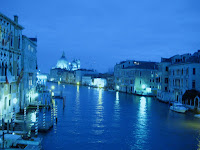
1. I will take photographs on the Academia Bridge each morning and evening on my ways to and from the Peggy Guggenheim Collection. At the end of my stay here it will be interesting to view how the environment changed over the three months and recall the extraordinarily beautiful days. To the right is a photo I took while crossing the Academia this weekend - I have not altered the colors of the photo at all, the night was actually florescent blue!
2. I will take photographs of every Madonna and Child shrine I see here in Italy. From an artistic perspective it is amazing to view the many different interpretations of their image, from a sociological perspective it's inspiring to witness peoples' faith, and from a religious perspective it's beautiful to take part in peoples' prayer.

At the end of my stay here I will post albums with both logs.

Tuesday, January 19, 2010

A Passionate and Compassionate Woman

To Peggy, art was an antidote to war, a palliative, a healer. –Alfred H. Barr, Jr.

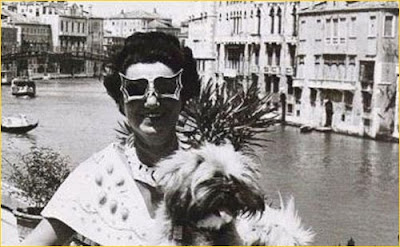
Peggy with her "baby" on the roof terrace of her home, late 1950's.

Having recently spent so much time with my new British friend Jessica Rolls, I’ve noticed that the voice in which I think is now speaking to me with an English accent. I realized this last night when I was lying in bed and began laughing out loud when the voice said to me “Gee, isn’t it a quite a shame that you haven’t written a bit on Peggy’s life yet?”

On that note, I want to begin this post by thanking a good friend Shifra Bronznick who gave me Confessions of an Art Lover, one of Peggy’s autobiographies, as a graduation and going away gift. Here are some of the facts and fun anecdotes that I learned from the autobiography, which I’ve already read twice. (By the way, for all of you art lovers and art lover wannabes out there, this book is a total must; it’s hilarious and it captures Peggy’s passion and spunk…)

Peggy was born in 1898 to what she describes as “two of the best Jewish families,” the Guggenheim’s, a metal owning family, and the Seligman’s, a banking family. Between loosing her playboy of a father to the Titanic catastrophe and having an entirely overbearing mother, Peggy claims to have had an excessively unhappy childhood. However, lucky for Peggy, at age 21 she gained access to her trust fund, making her financially independent and enabling her to move to Europe, where she took on the persona of the Peggy we now all know.

Upon moving to Europe, Peggy first settled in Paris where she met and married the American Dada writer and artist, Laurece Vail, with whom she had two children Sindbad and Pegeen, (to whom a small room in the PGC is dedicated). Through Vail, Peggy met Marcel Duchamp who became a lifelong friend and art advisor, helping Peggy to develop her artistic taste and build her tremendous collection. After seven years of marriage to Vail, Peggy and Vail divorced and she moved to London were she began a five-year relationship with English writer John Holmes, who died tragically young during a routine surgery. Peggy felt badly about his death throughout her life because he was her one true love and she knew that he passed because he was not sober during the procedure, due to their hard-partying ways.

After Holmes’ death Peggy opened her London Gallery, Guggenheim Jeune, with the help of Duchamp. (It was around this time that Peggy took British customs to court and won regarding the art case: see previous post.) After a year and a half Peggy closed Guggenheim Jeune because it proved to be much too expensive, as she ended up being the primary buyer of the exhibited works. In fact, Peggy anonomously purchased one work from every artist in every show at her gallery, in an effort to encourage the artists and support their movements.

After closing Guggenheim Jeune, Peggy decided to open a museum of contemporary art in London to house her collection and serve as an education forum. Given that art prices were good because of the economic hardships that lead up to WWII, Peggy determined that she would purchase one work of art a day until the opening of the museum, (which is when the Brancusi story comes in). Unfortunately, before the museum was able to get off the ground, Peggy was forced to hide her works in a barn in the South of France, (as the Louvre deemed her works too recent to be worthy of their storage space,) and seek refuge in the United States, so as not to be persecuted by the Nazis.

In 1941, Peggy arrived in New York, where she helped save a number of European Jewish artists, including Max Ernst, whom she married shortly after his arrival in New York. In New York, Peggy decided to open a gallery called Art of This Century. The gallery was unlike any other in terms of its interior decoration, which cost Peggy a fortune. Peggy says opening night was a real gala, “[I] wore one of my Tanguy ear-rings and one made by Calder, in order to show my impartiality between Surrealist and abstract art.” The first show was dedicated to her collection and the second to the objects of Laurence Vail, Marcel Duchamp, and Joseph Cornell, (whose boxes, which I find to be some of the most fun art in the collection, are on the fireplace in Peggy’s living room). Her third show was dedicated to the works of thirty-one women artists—amazing for the time—but unfortunately lead to the end of Peggy and Earnst’s marriage, as Earnst began an affair with one of the women whose work was in the show.

After that, Peggy focused the gallery shows on rising American talent, which is when she became heavily involved with Pollock, (not romantically,) and held his first one-man show, (see Pollock/Peggy post). During this period she also staged the first exhibitions for a number of young American artists such as Robert Motherwell, Mark Rothko, and Clifford Still. Because of this, I like to think of Art of This Century as the launching pad for abstract expressionism and Peggy, the mother of the movement.

In her autobiography Peggy says that her gallery had gained so much popularity that she was working around the clock and began feeling like a slave, and moreover she says, “Much as I loved Art of This Century, I loved Europe more than American and… couldn’t wait to go back.” So, in 1948 when Peggy was invited to exhibit her collection in the Greek Pavillion of the Venice Biennale, as the Greeks were in the midst of a civil war and could not be present, she made her big move.

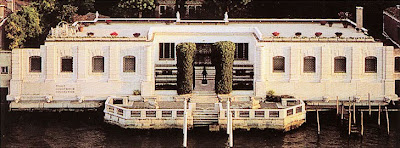
In 1949 Peggy purchased the Palazzo Venier dei Leoni, the home in which she spent the rest of her life. People were intrigued by Peggy and longed to visit her home, so in 1951 she began opening her home to the public during the summers for just a few hours a week. Of this time she joked, “Anyone is welcome to visit the gallery on public days, but some people, not understanding this, think that I should be included as a sight.” In other words, Peggy had become a full blown celebrity.

Despite having a tenuous relationship with her uncle Solomon Guggenheim and the staff of his museum, in 1969 Peggy graciously bequeathed her collection to the Solomon R. Guggenheim Foundation, under the condition that it would forever remain in Venice.

In 1979 Peggy passed away, however just before her death, Gore Vidal asked her how she was doing, to which she responded, “Oh, for someone dying, not bad.” And that was Peggy, a woman who embraced every experience life threw her way…

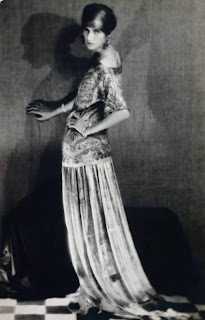
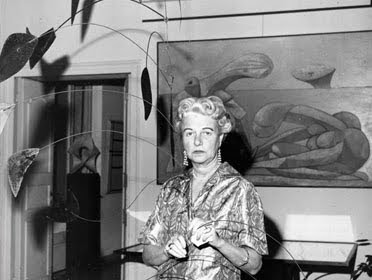
1. Young Peggy, 1924.
2. Peggy with children Sindbad and Pegeen Vail, late 1930's.
3. Peggy's Art of This Century, 1942.
4. Palazzo Venier dei Leoni, 1990's.
5. Peggy in her home beside works by Calder and Picasso, 1964.

Monday, January 18, 2010

Teaching

Along with guarding the galleries and helping out with various administrative tasks, the interns here at the Peggy Guggenheim Collection have the tremendous honour of giving a variety of types of public lectures, from ten minute talks on specific pieces in the collection, to talks on the life of Peggy herself, to full tours of the collection, which I gave for the first time yesterday! I focused my tour on both indoor and outdoor sculpture – fortunately the weather pulled through, my adrenaline was pumping, (masking my terrible cold,) and overall my tour was a great success! Since all of you, my favourite people, couldn’t be here for the tour, I thought it’d be nice to run you through three of the six works I discussed. (I promise I’ll share the rest another time!)
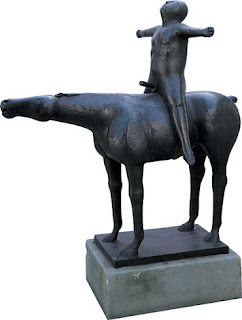
I began the tour with Marino Marini’s The Angel of the City (1948), for three reasons: 1) It is a work that is emblematic of the Peggy Guggenheim Collection; people think of this work when they think of the PGC. In fact, often before walking around, tourists ask, “Where’s Marino Marini?” (Marino Marini has become synonymous with The Angel of the City in PGC-Land.) 2) The sculpture is located at the original entrance to the palazzo. The current entrance to the museum was actually the back entrance when Peggy lived there and only when her home became a museum did the onetime back entrance become the main entrance. Thus, this sculpture was the welcoming committee for Peggy’s friends upon their arrival at her home. 3) You guessed it! For obvious reasons it gives everyone a good laugh!

On a serious note, Marino Marini has a tremendous amount of art historical depth. For example, Marini drew on the Northern European tradition of depicting war heroes on horseback, but of course he updated the look! In other words, he parodied a traditional subject matter to make it contemporarily relevant, or at least interesting. The Peggy Guggenheim Collection Guide explains that the sculpture is typical of Marini’s work because it affirms the strength associated with sexual potency. However, I like to think of this sculpture in simpler terms – this guy is a sexual hero!

Now for the juicy details… In Peggy’s autobiography Confessions of an Art Addict, she has a fabulous description of her relationship to the work: “It was a statue of a horse and rider, the latter with his arms spread way out in ecstasy, and to emphasize this, Marino had added a phallus in full erection. But when he had it cast in bronze for me, he had the phallus made separately, so that it could be screwed in and out at leisure. Marino placed the sculpture in my courtyard on the Grand Canal… The best view of it was to be seen in profile from my sitting-room window. Often peaking through it I watched the visitors’ reactions to the statue. I’d always take the phallus off before I had to receive stuffy visitors, but occasionally I forgot, and when confronted with this phallus, I found myself in great embarrassment. The only thing to do in such cases was ignore it. In Venice a legend spread that I had several phalluses of different sizes, like spare parts, which I used on different occasions (130-1).”

After discussing Marino Marini, and being briefly interrupted by the loud sirens of a boat ambulance, which nearly knocked over a gondola boasting extremely loud Italian accordion music, causing the passengers, (and my tour group,) to yell, we headed back inside for a look at Brancusi’s Bird in Space (1932-40).

I began this segment of the tour by explaining why Peggy’s sculptures are so important to the collection: In the late 1930's when Peggy was importing sculptures to London, for a show Marcel Duchamp had coordinated for Peggy’s gallery The Guggenheim Jeune, British Customs stopped the works at the boarder claiming that they were not art but rather raw pieces of bronze, marble, wood, etc. that needed to be taxed. (Mind you, the works were predominantly by artists whom we currently consider to be the most accomplished and famous sculptors of the 20th century, including Brancusi, Duchamp, Pevsner, Arp, Laurens, and Calder.) Peggy tried to get the director of the Tate to testify that her sculptures were in fact art, but he would not. Ultimately, Peggy took the government to the House of Commons, and won the case, thus legitimizing her objects as art. In her autobiography she notes that this was a great feat for foreign artists trying to send work to England because the case got marvellous publicity and was a great success. But it's important to note that she really helped the entire art world, and not just England; essentially, Peggy’s love for, and commitment to, modern art, was crucial to the 20th century expansion of the definition of art to include abstraction.

As for some background on Brancusi, he was born in Romania in 1876 and moved to Paris as a young adult to become a sculptor. In Paris he met Duchamp and other important artists, all of whom were friends with Peggy, which is how Peggy learned of Brancusi and became interested in his work. In Peggy’s autobiography she shares a funny detail about Brancusi. She says that when they’d get together, Brancusi would dress up like a homeless person and take her to extremely fancy restaurants where he’d order the most expensive things on the menu. Apparently Brancusi always wanted to be with Peggy, romantically, but she was never interested. Nonetheless, Peggy thought that by befriending him she’d be able to get a sculpture at a discounted price, however she was wrong because ultimately he charged her $4,000 for the work, which Peggy deemed obscene, and he cried as she took it from his studio…

The work itself is supposed to depict a generic bird flying upward. Art historians have suggested that Brancusi was a spiritual person and who longed to transcend the material world and he saw birds as symbolic of that desire. Likewise, he strategically worked with brass because he liked the finely polished product, as its luminosity is reminiscent of heaven, the nonmaterial realm. Ironically, the base on which the sculpture is mounted, seems to aggressively anchor the bird in our world, which makes me think that perhaps Brancusi felt that he could not fulfil his desire to detach from the material world.

Onto Giacometti’s Woman Standing (1947)!

Standing Woman is located in the Nasher Sculpture Garden, (the current front entrance)… After Peggy’s palazzo had already been converted into a museum, the Nasher family donated funds to enable the back courtyard area to be used as a sculpture garden that can house works from Peggy’s own collection, the Nasher collection, as well as works on loan from other institutions and artists. With that said, Giacometti cast Woman Standing, specifically for Peggy…

As for Giacometti, he was born in 1901 in Switzerland. He was a student of Rodin, and if you are familiar with Rodin’s work, you can see the influence, in terms of material and style, as both artists have a sad way of depicting the human body. Woman Standing is typical of Giacometti’s style with its crusty surfaces and just smaller than life size scale, and also because of its complex range of possible interpretations, a few of which I will propose to you:

1. Some believe that Giacometti was influenced by the images of Holocaust survivors and victims, which were just being released at the time this became his token style. As you can see, the figure is physically frail, vulnerable, and alone. However it’s interesting to note that Giacometti himself never admitted to being influenced by the trauma of WWII.

2. Giacometti himself has claimed that his strangely tall and thin figures are supposed to represent a person’s shadow, as apposed to the person himself.

3. Along those lines, Dr. Rylands suggests that Giacometti intends portray his model at the fixed view from which he saw her when sketching.

4. Sartre, the philosopher and art critique, claimed that Giacometti made elongated and emaciated figures because “there is nothing redundant in a living man because everything is functional,” and thus Giacometti simplifies people to their most essential qualities.

5. I believe that Giacometti intended to use his sculpture to remind viewers that humans are not perfect, as classical sculpture suggests. In other words, we are filled with dings and dents, hence the rough texture of Giacometti’s bodies, in contrast to the smooth finish of classical sculpture.

6. My favourite interpretation of Giacometti’s sculpture is from the Peggy Guggenheim Collection Guide, which says that Giacometti intends to capture the notion that even as we get older and the body begins to deteriorate, our essences are eternal and will continue to remain a part of this world.

And on that note, for the sake of ensuring that my body and spirit remain a part of this world for some time to come, I’m going to hit the sack at a reasonable hour so that I can recuperate from this cold and prepare for my talk on Peggy’s life which is coming up on Wednesday! Nothing better than being responsible for dispersing knowledge…

1. Marino Marini, The Angel of the City, 1948 (cast 1950?), Bronze, Peggy Guggenheim Collection, Venice.

2. Constantin Brancusi, Bird in Space (L'Oiseau dans l'espace), 1932–40, Polished brass, Peggy Guggenheim Collection, Venice.

3. Alberto Giacometti, Standing Woman ("Leoni"), 1947, cast November 1957, Bronze, Peggy Guggenheim Collection, Venice.

Wednesday, January 6, 2010

Memories

“Family that loves each other is the greatest gift and the best jewelry to decorate one's life with.” – Charlotte Kula, from her final e-mail to me on September 17th, 2008.

As I pass the hundreds of tourist kitsch shops while I walk the streets of Venice, I’ve been surprised by the many familiar tchotchkes that bring me back to childhood memories. Most of the memories are funny, for example I recall that my best friend Yael had the tiny glass animal figurines I see everywhere; she’d place them in the palm of her hand and quickly close her fist, opening it ever so slightly to give me a momentary glimpse of the creatures, before hiding them away again. (Okay Yael, I know what you’re thinking right now – yes, I did used to lie to you about there being real live miniature people, who only came out at night, inside that small flower shop dollhouse thing that hung on the wall near my bed…) However, there is one memory that’s particularly meaningful, as it reminds me of the most creative and devoted person I have ever known: my bubbi, Charlotte.

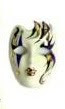
As a girl, each time I visited my father’s parents in Boca Raton, Bubbi would give me the privilege of selecting one piece of her jewelry, which I could keep, and take home with me as a gift, in exchange for one of my stuffed animals, which she’d “babysit” until the next time I’d come over to play. Bubbi was a terrific artist and craftswoman, and usually I’d select a pair of her homemade earrings, or perhaps a necklace. However, once I selected a pin with a mask that looks just like the image to the left. I don’t recall ever asking Bubbi where she’d gotten the pin, or who gave it to her, but I know I thought it was the most spectacular, wonderful little treasure, because I kept it on a shelf of precious things until my family moved out of our first home. I hadn’t thought about the pin since we moved, but when I saw it in the window of a tourist shop here in Venice, I was reminded of one of the first things I thought when I received word that I’d been accepted to the Peggy Guggenheim Collection Internship program, almost a year to the day after Bubbi passed away. Bubbi must have been there, watching over me, aligning the stars to ensure that I would receive this fabulous opportunity and it was for Bubbi, an artist, an art lover, a poet, a writer, and an unbelievable grandmother, that I would accept the position and keep a blog to document the experience.

So Bubbi, I dedicate this blog to you. Thank you for encouraging my creativity and always being the biggest fan of my artwork. As my six-year-old cousin Max put it best, “I love Bubbi, she was a great bubbi, I miss her.”