Check this out! Architects from around the world are currently competing for most appealing sukkah design. Twelve winners have been selected to have their sukkas fabricated and placed in Union Square for all to see until October 2. Through this process, people have the opportunity to learn about different types of architecture and to think about the meaning of this ancient holiday, which in the contemporary idiom serves to remind us how lucky we are to have such bountiful harvests / so much to eat, and remind us of our obligation to help those less fortunate than us, though who might permanently live in temporary shelters... Talk about how art can be a vehicle that adds meaning to life...
P.S. In my book the 900 sukkah will always be the winner!
Wednesday, September 15, 2010
Sunday, August 1, 2010
Performance

Jimmy DeSana, Marker Cones, 1982. Silver dye bleach print. Whitney Museum of American Art.
Yesterday Mitch and I visited the Whitney Museum of American Art, where there's currently an exhibition on performative actions captured through photo or drawing. We particularly liked Jimmy DeSana's Marker Cones (1982), which you can see above, because it reminded us of an experience of our very own, which you can see below.
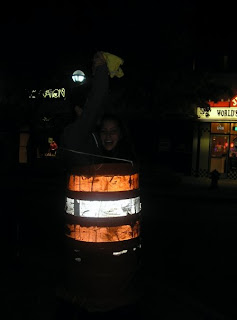
I initially loved the idea of capturing the essence of a performance in a snap shot, but after seeing DeSana's work and recalling all of the laughter brought about by getting stuck in a traffic cone with Mitch one silly college night, I was reminded that a still can never capture the full range of emotions that come with an experience. I'm not sure if that revelation was disenchanting in the sense that it made the exhibition less meaningful to me, or if it just meant that the works in the exhibition were a type of art other than performance, but it certainly made me nostalgic for my good old UofM days for the first time since graduating nearly a year ago...
Thursday, July 29, 2010
Meaningful Conversation
I just finished reading Richard Polsky's book I Sold Andy Warhol (Too Soon). On the whole I found it a bit kfetchy, (winy if you will), and cathartic in the sense that Polsky spends the entirety of the book recounting the history of the rising value of Warhol's Freight Wigs to ultimately make the point that he could have made more money had he been patient and not sold the one he owned so quickly. (A story not unique to the art world, after all everyone has a should have, would have could have story...)
 With exception to the book's great cover, the only other part of the book I found valuable was the following line: "Most paintings are like one-liners; once you get it, that's the end of the experience. The best works of art...reveal something fresh whenever you look at them (p.237)."
On that note, Mitch and I have begun what I'm calling "virtual collections." This means we've created photo albums on Facebook that contain images of works of art that speak to us in some way - images we are happy to look at again and again because of their aesthetic, symbolic, or narrative qualities. We're hoping this idea will be contagious and that many people will start creating virtual collections...
My father pointed out virutal collections are a form of "disruptive innovation." Disruptive innovation is Clayton Christensen's theory that innovations disrupt existing markets by creating products or services that are more accessible, and though they are often less powerful they are still good enough to get the job done. So, while virutal collections may not be as moving or inspirational as seeing the real works in say a museum, for most people they might be good to get the job done, good enough to encourage them to think about art!
Perhaps the best part of virtual collections are that they can provoke conversations that start with, "Hey, I saw that new piece you posted... What do you like about that piece? What's that piece about?" As apposed to, "Saw you hit up another party last week..."
After all, there's nothing better than meaningful conversation - supposedly it's the key to happiness!
 With exception to the book's great cover, the only other part of the book I found valuable was the following line: "Most paintings are like one-liners; once you get it, that's the end of the experience. The best works of art...reveal something fresh whenever you look at them (p.237)."
On that note, Mitch and I have begun what I'm calling "virtual collections." This means we've created photo albums on Facebook that contain images of works of art that speak to us in some way - images we are happy to look at again and again because of their aesthetic, symbolic, or narrative qualities. We're hoping this idea will be contagious and that many people will start creating virtual collections...
My father pointed out virutal collections are a form of "disruptive innovation." Disruptive innovation is Clayton Christensen's theory that innovations disrupt existing markets by creating products or services that are more accessible, and though they are often less powerful they are still good enough to get the job done. So, while virutal collections may not be as moving or inspirational as seeing the real works in say a museum, for most people they might be good to get the job done, good enough to encourage them to think about art!
Perhaps the best part of virtual collections are that they can provoke conversations that start with, "Hey, I saw that new piece you posted... What do you like about that piece? What's that piece about?" As apposed to, "Saw you hit up another party last week..."
After all, there's nothing better than meaningful conversation - supposedly it's the key to happiness!
Wednesday, July 21, 2010
Truth
"Judaism is not about being Jewish, it's a Way to be more deeply human."
-Rabbi Irwin Kula
"Art is a human activity having for its purpose the transmission to others of the highest and best feelings to which men have risen."
-Leo Tolstoy
This weekend I stayed at my friend Caroline's for Shabbat. Caroline and I met at Camp Hillel, a Modern Orthodox sleep-away camp, and though we express our Judaism in very different ways, we have been dear friends for nearly ten years.
During a conversation about our observance levels, Caroline said to me that she often feels regretful for not being more observant than she is. When she told me this, I said "--but Caroline, you are the most observant person I know! You only wear skirts below the knee and shirts to the elbow, you observe Shabbat in every sense, pray at least once a day, keep the strictest version of kashrut, and the list goes on! You observe the halachot (traditional jewish rituals/legal practices) that make your life meaningful to you. It's not about doing everything."
"I guess," Caroline said.
Dissatisfied with Caroline's answer I channeled my father and said, "What I mean is that the point of halacha is to increase your consciousness toward all your daily activities, to heighten your awareness of what's going on in the world around you, and to thereby enhance your quality of life, halachot are tools we can use to help us live more humanly."
"No," Caroline responded. "It's not always about making life meaningful, sometimes it's about observing a law, whether you understand it or not, simply because it's written in the torah and the torah is the truth."
I understood that Caroline meant that at times the meaning of the halachot rest in surrendering, not searching for the immediate utilitarian purpose, an experience that in and of itself helps us live more humanly and ethically. However, to me, there is much more to living truthfully than following halachot, as deeply humbling and affirming as that can be.
***
I am definitely "religious." To me, being religious means being profoundly in touch with the spiritual, practical, ethical, or cultural components of one's religion.
My father is a Rabbi - in fact he's a seventh generation clergyman - religion essentially runs in my genes. My parents traditionally observe halachot like kashrut and the sabbath, and culturally speaking we're as Jewish as can be: we live on the Upper West Side of Manhattan, go to Miami for Passover, love and visit Israel even though we sometimes disagree with Israeli political decisions, and schedule all activities around food, (more about that another time)... To top that off, my sister and I studied at yeshiva (Orthodox Jewish day school) through 8th grade, went to high school at a pluralistic Jewish day school, and reinforced our Jewishness by attending synagogue on sabbaths and holidays.
At S.A.R., my yeshiva, I learned fundamental Jewish values that will stick with me for a lifetime: respect, gratitude, inclusivity, devotion, and a love for learning - to name a few.
At Heschel, my Jewish high school, I learned to aggressively challenge tradition while remaining deeply proud of my Jewish heritage; I learned the importance of innovation and social activism, and I found that Judaism is not so dissimilar from other religions and thus bridges are better than boundaries.
At synogogue, I found role models in strong, high powered women who are leaders of the egalitarian movement. I also learned the importance of community and the true meaning of Bill Withers' song "Lean on Me" - in fact, my community is the tightest knit I've seen.
And in my own home I learned to integrate into my daily life all of the values I described above, and I learned the incomparable value of family.
Though some would say I am no longer halachicly observant, I do still honor all of the profoundly Jewish values I've just described.
Take social consciousness, respect, and gratitude as examples. I live those values daily through my own version kashrut. When I am in the supermarket, though I do not look for the hashkacha (rabbinical seal of kashrut), I do look at every ingredient in everything I buy to ensure my health and the health of those I am cooking for. I try to buy grass fed, hormone free meats, and organic, local produce, in an effort to respect the animals, the planet, and myself. I make an effort to eat slowly, consume food in moderation, and think about how blessed I am to have enough to eat and to have a choice of what I eat each time I sit down for a meal.
As for inclusivity, family, and community, I live those values through the ways I practice shabbat. I may use electricity, transportation, and money on the sabbath, but regardless every Friday night, I make sure to eat with family and friends. Moreover, though I have not lived with my parents in four years, I've never forgotten to call them for my blessing. (It is customary for parents to bless their children at the beginning of the sabbath.)
Regarding devotion, learning, and challenging, though I don't actively study the bible, I do read about what's happening in the world on a daily basis, I don't blindly accept what I'm told, and I put my all into any task I set out to accomplish.
***
My Bubbi Charlotte, Z"L (of blessed memory), used to always say that if you are astutely aware of the world around you, bring a sense of consciousness to everything you do, and embrace peoples' differences, you will see that everything and everyone is a piece of art.
Following with this thought, my Poppi recently taught me that the hebrew word for artist is AMN and the hebrew word for art is AMaNüt; the roots of those two words are the same as the roots of the words AMeN, which is said after a blessing and means truth, and AMüNa, which means faith.
***
To both me and Caroline, life's about bringing people together by accepting and working to understand others ("Love thy neighbor as thyself"), living ethically and bringing passion to everything we do (gemilut chasadim and avodah), and expressing ourselves in ways that beautify and help the world (tikkun olam).
Whether you consider that torah or art, we can all agree that by living out these values, we are living faithfully, we are living the truth.
Wednesday, June 30, 2010
Discoveries

Okay, so Eilidh Crumlish is not really my discovery - I actually happened upon her on Eyestorm, but her art is awesome, right? (For those of you who don't know Eyestorm, you should check it out; it's a cool website that makes the purchasing of art accessible by showcasing up and coming artists whose works are [for the most part] not outlandishly priced.)
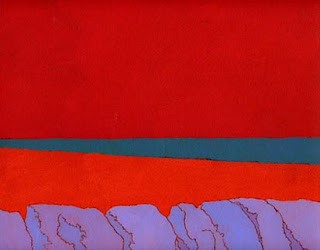
I'm drawn to the colors Crumlish uses, the layouts she chooses, and her off the beat style that lies somewhere between Impressionism, Pop Art, Colorfield Abstract Expressionism, and Arts & Crafts... More specifically, she paints outdoors in Italy and Scotland, often creating large planes of solid, sometimes in-your-face colors, using plywood as her canvas, and occasionally inserting kitschy patterns.
While I could do without the wallpaper-esque patterns in some of her works, (which you can see on her website, as I'd rather not copy them into this post,) I do like the natural swirly pattern that's a product of the plywood she paints and prints on. In fact, I emailed her to see if she ever shows in NYC because I want to see what the unique wooden texture does to the feeling of the work; unfortunately, I never heard back from her so I guess I'll just have to imagine for myself, unless any of you know where I can see her work...
Having recently determined to begin purchasing original works of art, (part of the reason I want to see Crumlish's work first hand,) I have been showing Crumlish's work to friends, fellow gallery girls, and family... Here are some reactions:
"Like Rothko." (Certainly true in the case of the above work, though Crumlish's work is obviously less abstract.)
"Like Michael Craig-Martin." (Subject matter is entirely different but I do see the similarities in Craig-Martin's colors and the colors Cumlish used in the work below...)
Thoughts?
Sunday, June 27, 2010
Abstract Expressionism
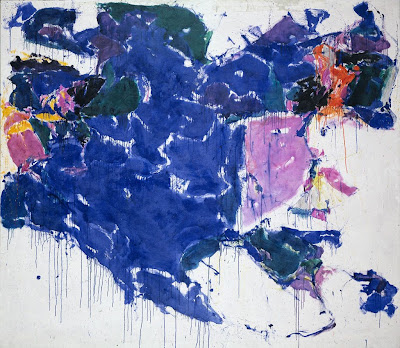
"For me, the greatest pleasure of all, is that long standing devotion to that long, large, tall white canvas. It's a labor of love, you know, as if you are walking over the surface of this terrific continent..." -Sam Francis
It's official. Abstract Expressionism is my favorite movement. (Oh how American of me!) Color Field, Gestural, I love it all because when looking at a painting I am drawn, first and foremost, to color and motion, or movement, two defining Abstract Expressionist traits.
In what is essentially the basement of the Hirschhorn, (a museum whose space I don't particularly love, although my recent private tour of their mind blowing Yves Klein show by fellow PGC intern, and current Hirschhorn intern, Mark Rosen, did make me think otherwise,) is a map-like Ab-Ex painting that I have always been attracted to because of its beautiful colors, which rest on a defining, clean white background.
I never thought much about the artist of the painting, because, for better or worse, I often deliberately neglect to look at the text panels on museum walls. (It's part of my whole riff on empowering the viewer to have confidence in his interpretations and find value in art apart from the name of its artist.) That was until this May when a Sam Francis show opened at the Helly Nahmed Gallery, which I pass everyday on my way to Gagosian. In the window of the Nahmed Gallery hangs a large banner stating "Sam Francis". Upon my very first glance into the gallery, I learned: favorite Hirschhorn painting = Sam Francis. I tend to stay away from equating artists with their works, (or to paraphrase Rothko in RED, which I saw last night, 'I hate when people use my name as a noun,') but the nature of the sign in the Nahmed window disabled me from separating Francis from his work, thus encouraging me to learn about Francis and the light his history might shed on his paintings. (Roland Barthes, writer of "Death of the Author," would kill me for saying that...)
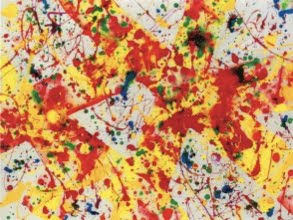
To start, Francis was a California boy born in San Mateo in the 20's. In the 50's he moved to Europe for a bit to study, returning to California in the 60's for the last nearly forty years of his life, which is when he produced many of his iconic works. This fact about Francis' background is apparent from one's very first glance at the works in the Nahmed Gallery show. Unlike the inspiring Francis painting from the Hirschhorn, most Fracis paintings on display at the Nahmed Gallery, have a typical 80's L.A. look - think fine art inspired by Saved by the Bell, Johnny Rockets, or a Midwestern diner modeled in that style and not updated since.
However, other Francis works, such as the one above called Blue out of White(1958), have this ideal balance between the styles of Mark Rothko and Jackson Pollock. This is a controversial statement, as many believe that Francis' rise to success came from his vastly different approach to painting than Rothko and Pollock, however undoubtedly they were two of Francis' influences, and in my eyes, Francis has Rothko's profound color sensibility, (a complimentary label that the angry Rothko despised,) and Pollock's motion, his drive for action...
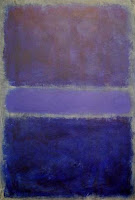
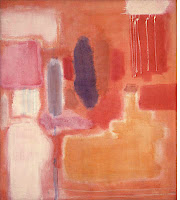
Unfortunately, Blogger makes it difficult to place images side by side, but if you look at Francis' Blue Out of White and then the two Rothko's I have placed near this paragraph, you will notice that they use similar, almost complimentary colors. (This example being one of many possible comparisons.) In fact, both artist's believed that their purpose was to express human emotion, which in a visual idiom can be achieved through the employment of colors.
As for the Francis/Pollock comparison, watch the video below and you will see that Francis paints much like Pollock, standing over his canvas, walking around it, using large gestures. (Scroll down to watch a Pollock clip that looks quite similar...)
Yet Francis' unique spin on Ab-Ex is the map-esque feeling he creates through his captivating white backgrounds and frequent use of blue. As the daughter of Irwin Kula, and an Upper West Side kid unavoidably influenced by Freudian psychology, I felt in my bones that that feature has symbolic, if not unconscious, value.
Lo and Behold, my inkling was partially true. (I think I should start capitalizing the first letters of the words Partial Truth, since in my family those words are practically sacred, worthy of proper noun status.)
I say Partially True because Francis was associated with a movement called Tachiste, which some people call the European counterpart to Abstract Expressionism. The movement has not been widely written about, so understanding its precise premise has been a bit of a difficult task for me. Of the movement, the Hollis Taggart Gallery's website says "Artists in the group developed a style of gestural action painting that reflected an expressive, painterly aesthetic and the artists' desire to highlight the beauty of their materials, as opposed to portraying psychological or philosophical concerns." According to this understanding of Tachiste, works produced by artist's of the movement are essentially void unconscious intentions.
However, unable to accept the notion that Francis' works have no psychological implications, I further investigated the Tachiste movement and found that the Taggart Gallery's description was not quite right. The Tachiste movement is based on the longing to express, or create the artist's mark. In fact, it's related to the Art Informal movement, which is premised on the importance of depicting the artist's inner being, whatever that might mean...
Francis' affiliations with those movements closely ties to the map-like feeling of his paintings, a quality I've mentioned several times. Francis was inspired by a Jungian therapy technique that helped him recall his dreams that often related to nature, particularly water and air, levitation and gravity.
Yet that is not the only possible meaning of Francis' paintings' earthly feelings. In an Art in America article published last year called "Best in the Studio: The Art of Sam Francis," author Darrell Hartman suggests that Francis began prioritizing negative space as a means of creating portals into new dimensions, after learning about the Japanese ma.
I'd like to suggest, perhaps more simply than other interpretations I've noted, that Francis' map-like creations stem from his conscious or unconscious recognition that his style was influenced by a number of cultures from across the globe. After all, he was born on the west coast of the U.S.; he spent time in France where he learned about Japanese culture and determined to travel to Japan to learn about different forms of Buddhism; he studied Jungian psychology, which is of Swiss origins; and his role models were Pollock who himself was influenced by Mexican and Native American cultures, Rothko who was Eastern European, and Clyfford Still who lived all over North America.
Perhaps we'll never know the answer, or perhaps this is another case of the Partial Truth, but in an effort to search, I'm off to watch the 2008 documentary The Painter Sam Francis.
1. Sam Francis, Blue Out of White, 1958. Oil on canvas. Hirschhorn Museum and Sculpture Garden, Washington D.C.
2. Sam Francis, Untitled, 1992. Acrylic on paper. Helly Nahmed Gallery, New York City.
3. Mark Rothko – unfortunately I can’t find the tombstone information for this work online…
4. Mark Rothko, Untitled, No. 9, 1948, oil on canvas.
Thursday, June 24, 2010
Subscribe to:
Posts (Atom)