Wednesday, April 28, 2010

Beauty

I can't pinpoint what it is about this photograph that is so captivating to me, but I've been sitting with it here on my desktop for over a week now, so I thought that with or without anything to say about it, it's worth sharing.

I found it while scanning the MoMA website. It's by American artist Lee Friedlander, who's known for photographing musicians, working poor, and sexual/erotic but none-glorified nudes.

This woman has a beautiful body. Not a perfect body, but a real body. A body that appears to have been taken care of lovingly - she hasn't under eaten, or over indulged, she hasn't been ravaged by painful beauty trends, but she also hasn't disregarded any aesthetic sensibility.

This photo is like the artsy version of the "Dove Campaign for Real Beauty." For those of you who don't know / remember, in 2004 Dove launched a campaign shot by Rankin, who I'll dub 'photographer of regular people,' intended to broaden the stereotypes of beauty by featuring regular women, (as apposed to professional models,) of various shapes, sizes, colors, and ages. The women in the advertisements were not thin, but they were also not unhealthily overweight. They were just regular women, doing what they could to feel good about themselves in a culture that is overly focused on body image. Simultaneously, Dove founded the "Self-Esteem Fund," which has positively effected millions of women and girls, through the programming and funding of self-esteem building workshops, which you can learn more about on their website.

Unrelated in terms of subject matter, but related by artist and medium, the photograph below is a more recently shot Friedlander work that has captured my mind.

I've always loved trees because in Jewish culture, and for that matter in many cultures, they symbolize life, hence the Tree of Life. Trees have this amazing capacity to be reborn each year, to start fresh each spring, proving their commitment to life; they become stronger and more beautiful despite having just endured another painful winter, another painful moment. They sprout branches and buds filled with fresh flowers and foliage, as if giving birth to new life which then floods the earth with a colorful petal and leaf shower, just as people conceive of ideas and send them into the world, creating and inspiring.

Incase the mere elegance of Friedlander's tree in not enough, he also captures the shadows it creates rather magnificently through his wide-angle lens, thus producing the illusion that the ground is not just grass covered soil, but rather the earth – round, full, and boundless.

While I was in Venice, I read Toni Morrison's Beloved, a painful story of a broken family doing the best they could despite the relentless hardships of slavery and the supposed freedom that should, but doesn't, come with being an emancipated slave. I highly recommend the book, if not simply for the heartbreaking, provocative story, also because Morrison is one of the most eloquent writers I have ever read – there’s something about her use of metaphors, creative and poetic metaphors… I brought that up because at one point in the novel she describes the shadows of the family holding hands. This idea, or metaphor, continues to captivate me because it expresses the notion that even when things aren’t perfect in reality, or they aren’t perfect right now, beauty, happiness can still be found – a piece of wisdom everyone can appreciate.

Morrison’s insight on shadows led me to do some research on the mysterious silhouettes. I found that in Jungian psychology, the shadow is a part of the mind filled with weaknesses and shortcomings, the types that we repress. Ugh, have shadows become my latest fascination as unconscious suggestion that I need to be doing a better job self-reflecting, self-critiquing? Do I need to become more self-aware? I don’t know if I can handle that!

So, Jungian shadow theories aside for now, here are a few of my own thoughts on the subject of shadows: perhaps they speak to a longing for insights about the past and the future as they fall behind us and then run ahead again; perhaps they remind us to seek meaning in that which is not perfectly clear, to accept that an outline is a good start; perhaps they serve as a metaphor for the connections between light and dark moments; or perhaps they are nothing more than a beautiful subject for a photograph.


  1. Lee Friedlander, Nude, 1980. Gelatin silver print. MoMA, New York.
  2. Lee Friedlander, Tarrytown, New York, 1992. Gelatin silver print. MoMA, New York.

Monday, April 26, 2010

A Step in the Right Direction

Nowadays, with the availability of cheap and frequent flights, all types of people have the opportunity to travel. And of course, with the all too common, excessively long delays and unavoidable layovers, travelers spend more time in airports than ever. The San Francisco art community has capitalized on these fortunes and misfortunes, by bringing art to the airport - art to the masses. The San Francisco International Airport is the first airport to be accredited by the American Association of Museums, housing exhibitions loaned from other institutions as well as exhibits planned specifically for the airport. Statistics show that some 10% of people passing through the airport actually stop to take a look at the works on display, which are changed and rotated on a regular basis so as not to bore frequent flyers. In a given year well over 350,000 people take note of the eclectic art displayed in the airport! That means that each year there are 300,000 more art viewers at the airport than at the average museum!*

For those of you who don't know, my life goal is to make art available and accessible, physically, psychologically, and intellectually, to people from all backgrounds. Thus, in my mind there is nothing greater than public art that engages people, capturing their attention by provoking thought and raising questions, in the way the art at the San Francisco airport does.

The existence of programs like the S.F. airport-museum program is particularly important at this period given that traditional museums, much like churches, synagogues, and temples, no longer work for most people. More explicitly, the main goal of such institutions has always been to add meaning to people's lives, however I speculate that for most they no longer do so for two main reasons: 1) People have found other outlets to stimulate them and produce meaning in their lives, even if those outlets are sometimes bunk, i.e.: television. 2) People want instant gratification; in a fast paced society, people don't have time to visit an institution that only has one function, nor do they have the attention span necessary to do the research that makes the tool, be it prayer or art, function.

Given these pending problems, here are a few key questions we must address in order to fulfill people's needs as we enter this new stage in human development: how do we produce bite-size (not in the physical sense) art that isn't dumbed down? In other words, how do we make art accessible to people, including people with no art historical knowledge, without sugar coating it or diminishing its multitude of dimensions? How do we provide people with the opportunity, and perhaps even encourage people, to engage with art on a regular basis and how do we make such art understandable? What is the best forum through which to do this?

Off the top of my head I can think of several important artists who have used public art to engaged large numbers of people, making them conscious, aware of their daily routines / existences and asking them important question about society at large.
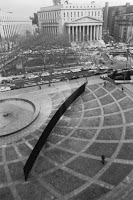
Take Richard Serra and his Tilted Arc (1981), which was commissioned by the U.S.'s General Services Administration Arts-in-Architecture program. Titled Arc was designed by Sera in 1981 and placed outside of Federal Plaza that year. The work called attention to the space in which it laid, a place that thousands of people passed through daily, without ever thinking about or noticing - in other words, regular passersby took the space fore granted.

However, once the piece was put in place, people finally began to notice the space it occupied! In fact, it caused such a ruckus that after a long and heated public debate Titled Arc was taken down because it was so disruptive! Some people feared that it was a terrorist threat because bombs directed at the federal building could be thrown over it; it prohibited others from taking public transport at night because they worried about the invisibility of people on the other side who could potentially mug, or harm them. It caused people to question their notions of security, of familiarity, and it forced people to live with a greater sense of awareness, to live more conscientiously, more alertly. Additionally, it became a target for urination, which brought up questions about homelessness, about poverty, and how on both governmental and grassroots level poverty related issues must be dealt with. And of course, the fact that this mammoth, shield-like work that was ultimately disruptive and upsetting, was installed in Federal Plaza, undoubtedly calls attention to the role of the government as both protective and at times oppressive.

In one concise sentence, Tilted Arc, changed the entire environment of Federal Plaza, forcing people, both consciously and unconsciously, to question and make meaning of societal issues they had once overlooking and parts of their lives that had simply become routine.

I don't know if you'd consider this attempt at capturing people's minds, guiding people to think about meaningful and important aspects of life and society, successful given that Tilted Arc's presence in the public sphere elicited frustration, annoyance, and even anger, but at least it made big a enough stink to bring art into the public sphere!


1. Richard Serra, Tilted Arc, 1981. Steel. Federal Plaza, NYC. Dismantled in 1989.

* To read more about SFO museum project, check out an article called "Flying Through San Francisco? Stop to Enjoy the Art," on the NPR website.

Tuesday, April 13, 2010

Being Back!

"New York City... the center of the universe." -Angel, Rent

Go ahead, write me off as another crazy New York egomaniac, but honestly there is nowhere I'd rather be than right here in NYC. I've been home for less than a week and I've already wandered through neighborhoods that are homes to various cultural mini-meccas; I've seen some provocative public art like the creations on the Highline, (and arguably the Highline itself); I've explored the parks in a state of bliss inspired by the color green, (which does not exist in Venice,) and the hyperrealistic, dare I say romantic, blooming cherry blossoms; I've gathered my fashion bearings through a hefty amount of window shopping and perhaps a bit of real shopping as well; I've seen types of people I never imagined existed, (man walking another man on a leash?); and I've obtained an internship position at Gagosian Gallery. Need I explain further?

For those of you who don't know of Gagosian Gallery, I urge you to visit the gallery's website at www.gagosian.com, because it is undoubtedly one of the most important galleries in the world with several national and international locations. Gagosian has exhibited countless huge name artists, and I'm talking mega stars: Basquiat, Calder, Fontana, Giacometti, Gorky, Klein, Kline, Koons, Lichtenstein, Manzoni, Murakami, Picasso, Pollock, Serra, Twombly, and Warhol, just to name a few personal favorites. The gallery has always exhibited, represented, and sold art contemporary to the given period, as well the modern masters. In fact, Gagosian often helps to cement artists into the western cannon - think Jeff Koons and Cy Twombly - selling their works for record breaking prices, (see ARTNews, the Economist, and the NYT for details). Speaking of financial success, Wikipidia shared with me that in 2006 Gagosian sold William de Kooning's Woman III for 147.9 million dollars, making it the second most expensive work ever sold. Money aside, one of the qualities that differentiates Gagosian from most galleries is their museum scale exhibitions. In fact, in yesterday's NYT Arts section there is an article by Roberta Smith titled "Artful Way To Expand A Museum," in which she proposes that the Whitney hire Larry Gagosian as a consultant to help them create a successful downtown offshoot. The article ends with a statement on Gagosian's recent Calder exhibition, "It was a heart-stopping, art-loving show that rewired and strengthened both the sense of Calder's greatness and one's own personal ability to see art. Affirmations like that keep people coming back." Now, you can't get a more glowing review than that, eh?

Though all of the exhibitions currently on display at the Gagosian Galleries are notable, there is one artist, Tatiana Trouve, who I'd like to share a bit about. Trouve is an Italian born, Paris-based artist whose work often embodies dualities, namely the interplays between fiction and reality, as well as memory and matter. Her most well-known project Bureau of Implicit Activities (1997-present) is a large scale installation that incorporates forms of art ranging from drawing to architecture. Currently containing 13 modules that have been exhibited both together and separately, the work tells the story of Trouve's path to becoming, and career as, an artist. Her works are eerily absent of any direct depictions of human, mysteriously ambiguous when it comes to time, and magically able to raise an infinite number of questions on everything ranging from science to Trouve's own biography.

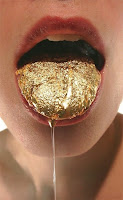
While we're on the topic of contemporary female artists, I received word from E-Flux on an exhibition opening in May at the Contemporary Arts Museum Houston, called Hand+Made: The Performative Impulse in Art and Craft. The exhibition will display works that utilize traditional craft techniques in an innovative way, thereby blurring the boundaries between the once distinct categories of craft and art. The piece to the left by Lauren Kalman called Hard Wear or Tongue Gilding (2006), will be shown in the exhibition and is a prime example of this trend.

1. Lauren Kalman, Hard Wear (Tongue Gilding), 2006. Digital print, laminated on acrylic. On loan from artist to Contemporary Arts Museum Houston.

Sunday, March 28, 2010

The End...

... If only because I've learned so much about art, myself, and life at large... Dyanu!
... If only because it means new beginnings... Dyanu!

Wish I had some wonderful, introspective, retrospective insight about my three months in Venice, but as I lie awake in my bed, on the last night I will call this my bed, all I can think about is how blessed I am to have had this experience and how lucky I am to top it off with a trip to Miami, where I am meeting my family for Passover... Chag Sameach!

Friday, March 26, 2010

Obsessions

Turns out Tuey and I have a mutual idiosyncrasy: we both listen to our favorite song of the moment on repeat until a new song becomes the favorite, at which point we listen to that song on repeat. Fortunately we have very similar taste in music - listed chronologically, are our favorite songs of the PGC experience, give or take a few.

1. John Mayer,
Who Says (2009)
2. Alicia Keys,
Sleeping with a Broken Heart (2009)
3. Graham Nash,
Simple Man (1971)
4. Great Lake Swimmers, I am Part of a Large Family (2007)
5. Ryan Bingham,
Weary Kind (2009)
6. Lykke Li,
Little Bit (2007)
7. The XX,
Islands (2009)

I always say that I wish I could have someone psychoanalyze me based on my top ten most played songs. In this case, I think I have a pretty clear understanding of why I was drawn to these songs in this order. The more comfortable I became here, the more open I was to listening to edgy, experimental, (or as some might say, synthetic,) music. In other words, as I settled into my Venetian lifestyle and routine and began to feel content and safe here, I was able to stretch, or open my mind, to new sounds.

Ironically, in my first post from Venice I wrote that the best way to learn is to put myself outside of my comfort zone, and here I am saying goodbye to Venice and noting that some of the best learning came in the moment when I felt comfortable again... Funny how the mind works...

Thursday, March 25, 2010

Public Art

This week I gave my PGC seminar! I didn't end up discussing feminism through the lens of instillation art, as I had previously mentioned, rather I spoke about "Creations of Cultural Collisions: The Art of Intercultural Interactions." I discussed the ways artists respond to the range of reactions to cross cultural contact, from the most detrimental, such as obliteration and colonization, to the most healthy, for example acculturation and multiculturalism. Sadly my PowerPoint didn't translate from my Mac to the PGC's PC, but I think the talk was successful nonetheless because it provoked interesting conversation amongst my audience of fellow interns. I'm hesitant to share my thoughts on the subject of my seminar through my blog, as my peers suggested I turn it into something more than a presentation at some point in my life, so if you are interested in learning about this topic feel free to shoot me an email or give me a ring.

Anyway, the real reason I'm writing this post is to share with you what I learned from Mark Rosen, who gave his seminar just after mine. Mark was a student at the University of Texas at Austin, when they received a long-term loan of twenty-eight sculptures from the Metropolitan Museum of Art in New York, (mind you the largest loan of this sort that the Met has ever offered). In an effort to help his fellow students and visitors understand the meaning and the importance of the works that were strategically placed around campus, Mark created a docent training program by researching all of the pieces, movements, and artists by whom they were made and subsequently devising extensive educational materials. During his seminar, Mark took us on a virtual tour of the UT campus, explaining each of the sculptures he finds most interesting along the way.

In an effort to feature women artists on my blog, I will share with you what I've learned about a piece by Louise Bourgeois called Eyes (1982), which Mark brought to my awareness during his talk/tour. Eyes weighs over 11,000 pounds, which is so much that the infrastructure of the building in which it's housed actually had to be strengthened in preparation for it's placement in the atrium! At age 71, Bourgeois hand carved this mammoth block of marble to appear as though eyes are bulging from the top of a dwelling structure. Eyes are a popular Surrealist theme that tend to symbolize perception and the female anatomy. Seeing as feminist messages can be found in many of Bourgeois' works, art historians have suggested that this work is intended to raise questions about the role of women in relation to the home. The work also touches on the theme of the interaction between nature, human creations, and machine made objects - as you can see parts of the block of marble appear to be incomplete, referencing their natural origins, while the parts that are complete, so to speak, appear to be smoothed by machine, though the work was completely finished by hand.

An interesting note about the placement of Bourgeois' sculpture is its relationship to the work that lies in front of it, just outside of the building, which is by another female artist, Magdalena Abakanowicz and is called Figure on a Trunk (2000). The work proudly stands blocking pedestrians from entering the building using a direct route, but despite its unavoidable presence, the figure has no head and looks as though it could easily be knocked right off of the wobbly logs on which it is balancing. Thus, to get into the building you must first face the flimsy headless man and then bypass the 11,000 pounds of (female) eyes. I'll leave you to make of that as you wish...

As I mentioned above, there are 28 works on the UT campus that are on loan from the Met, however UT hasn't stopped their public art endeavors there... They have sponsored three more artists to infuse their campus with additional creativity. To learn about artists 1 - 28 check out the UT Landmarks website at landmarks.utexas.edu . As for artists 29 - 31, some pretty cutting edge players, here is a brief rundown. 29 is Mark di Suvero with his work Clock Knot (2007). Clock Knot's title was given by a poet who saw in the work both the hands of a clock, as well as a knot. Whether you see the clock, the knot, or not, you have to admit that the play on words is kind of cute. Interestingly, di Suvero is handicapped, but still physically engages in the productions and installations of his works. Another nice anecdote about the artist is that his materials are almost all recycled and the creation of his works always have some community service aspect to them. ALSO, fun fact for all of you UofM folks out there, that huge piece that was installed in front of UMMA upon its reopening is called Orion (2006) and it's by di Suvero! (And on a cute side note, one of the artists from the original 28 at UT is Tony Smith, whose Tau (1961-2) is outside of the main building of Hunter college, where I "studied abroad!" Represent.)

Because I want to save best for last, artist 31 is James Turell. His project is called Skyspace and won't be actualized until 2011, but seeing as he has done other skyspaces before, I feel confident saying that the premise of the project is to utilize light and space in art, as apposed to just alluding to, or discussing light and space, as so many artists do. To achieve this goal, Turell essentially frames the sky by creating a space with an opening in the roof! (Think ultra-modern Pantheon...)

And last but not least, artist(s) 30 is David Ellis & Blu. Radical, psychedelic, down right awesome... Watch this video of the work the produced for UT, it speaks for itself:


1. Louise Bourgeois
, Eyes, 1982. Marble. The Metropolitan Museum of Art New York.
2. Magdelena Abakanowicz,
Figure on a Trunk, 2000. Bronze. Metropolitan Museum of Art, New York.
3. Mark di Suvero, Clock Knot,
2007. Painted Steel. Mark di Suvero & Spacetime C.C., courtesy of Paula Cooper Gallery, New York.

Monday, March 22, 2010

Peace


Now aren't you in the mood to listen to The Ballad of John and Yoko (1969)? "The newspapers said, say what're you doing in bed, I said we're only trying to get us some peace... You know it ain’t easy, You know how hard it can be..."